| Find in this manual | ||
| Replace with | ||
helpx_waivers
Waivers
A number of roster transactions in the baseball world require a player to go through the waiver process, wherein a player is 'placed on waivers' for a certain number of days. This number is customizable in the Roster Rules section of the Rules page. While a player is on waivers, he can be claimed by any team in the league, which can then take ownership of the player and his current contract. If the player is not claimed, he is said to have 'cleared waivers', and his team can proceed with whatever transaction it was planning. In some cases, a team can remove a player from the waiver wire if it is notified that he has been claimed ('revocable' waivers). In other cases, it cannot withdraw the player ('irrevocable' waivers).
There are numerous tricky scenarios within the waiver process, and OOTPB does not quite replicate all the rules that exist in professional baseball. This section should give you a somewhat clearer picture of waivers in OOTPB.
When Must a Player Be Placed on Waivers?
In OOTPB, a team must place a player on waivers in any of the following scenarios.
1.The player is being removed from the secondary roster (this is called outright waivers).
2.The player is being demoted to the minor leagues from the major league club and is out of option years (this is also outright waivers).
3.The player is being demoted to the minor leagues from the major league club and has three or more years of major league service time (major league waivers).
4.The player is being released (unconditional release waivers).
Outright Waivers
When a player is placed on outright waivers, that player is made available to any team in the league that wants to claim him. If the player clears these waivers, the club can process the transaction it wanted to undertake (remove him from the secondary roster, demote him to the minors, and so on), as long as no other provisions need to be met, such as gaining the player's permission. This waiver is irrevocable, meaning that if the player is claimed by another team, he is lost by the waiving team with no compensation.
Unconditional Release Waivers
When a player is placed on unconditional release waivers, he is removed from all rosters (active and secondary) and made available to any team in the league at his current contract. If a team claims the player, it takes responsibility for his contract, with the waiving team receiving no compensation. A player placed on unconditional release waivers is free to speak to other teams about potential employment, but he cannot sign a contract with another team until he clears waivers. If a player is claimed on unconditional release waivers, he is told of his new team after the waiver period is over, and he has five days to decide whether to report to his claiming team or to terminate his contract. If the player elects to terminate his contract, he is a free agent but not entitled to any termination pay (in other words, the remainder of his guaranteed contract). This waiver is also irrevocable.
Major League Waivers
Major league waivers are used to demote a player who has three or more years of major league service time but who still has option years remaining. These waivers are revocable, so if a player is claimed during this time, the player can be pulled back and remain on the active roster. Major league waivers can be asked for a player only once in 30 days; if a player is placed on major league waivers a second time during this period, those waivers are considered irrevocable, and claimed players are lost by the waiving team with no compensation.
More commonly, major league waivers are seen after the trading deadline, typically from August 1 to the end of the major league regular season. Players who clear major league waivers during that time can be traded after the July 31 trading deadline, although most of these trades and waivers are done before August 31 in order for the newly acquired players to be eligible for the playoff roster.
Revocable versus Irrevocable Waivers
In some cases, a team can remove a player from the waiver wire if it is notified that he has been claimed ('revocable' waivers). In other cases, it cannot withdraw the player ('irrevocable' waivers).
In OOTPB, in waivers are irrevocable when you are trying to send a player who is out of options to the minors. They are revocable in other cases.
How Waivers Work
When a player is placed on waivers, he is made available to every team in the league for a certain amount of time, defined in the league setup. General managers can review the list of players on the 'waiver wire' on the Waivers page at any time, and can attempt to claim a player. If the waivers are irrevocable, then the claiming team claims the player. Once this happens, the general manager of the team waiving the player will receive a message saying that the player has been claimed. If the claim is revocable, the general manager of the waiving team will receive a notice that the player has been claimed and will have an opportunity to remove the player from the waiver wire. If a team claims a player off waivers, it takes responsibility for the player and his contract.
If a player placed on major league waivers is not claimed by another team during a certain number of days after waivers have been requested, then the players is said to have cleared waivers, and the team has secured waivers for the remainder of the waiver period.
What does that mean? Essentially, the team can do with the player's contract as it pleases. This generally means one of three events will happen.
1.It can send him to the minors (subject to his consent, if he's a veteran player; more on that below).
2.It can release him, which makes the player a free agent and thus available to sign with any team.
3.It can trade him to another team, even if the trading deadline has passed. Any trades made after the trading deadline can involve only players who have cleared waivers.
Waiving a Player
There are two ways to waive a player in OOTPB:
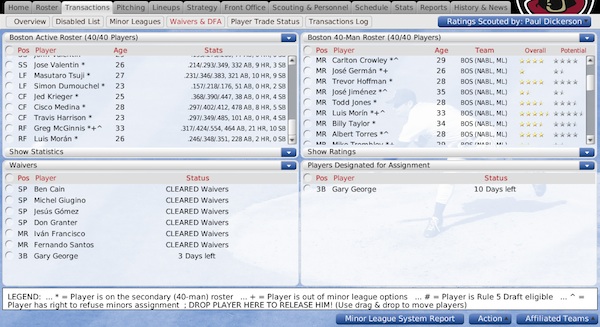
1.Go to the Waivers & DFA sub-screen of the Transactions page, and drag the player to the Waivers box, usually located in the lower left:
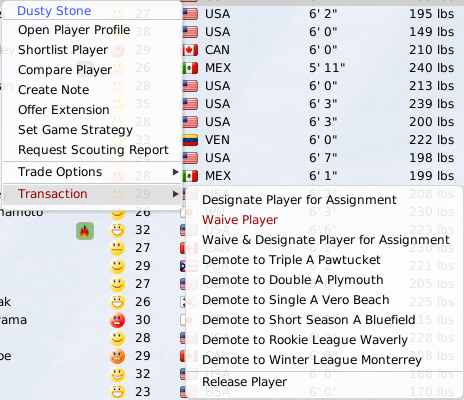
2.Right-click on any player, select Transactions, then select Waiver Player or Waive & Designate for Assignment:
Either way that you waive a player, you will receive this warning message:
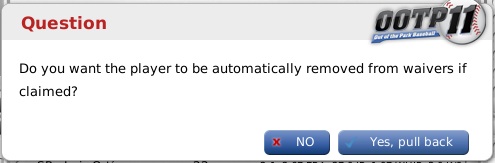
This option allows you to instruct the game to automatically pull back your player from revocable waivers if claimed by another team.
Once the waiver period has passed, you can reassign your player as desired.
Note: In the real world, waivers last for three business days, not calendar days. In OOTPB, waivers last for a certain number of calendar days.
When Your Waived Player is Claimed
If a waived player is claimed by another team, you will receive a message like the following:
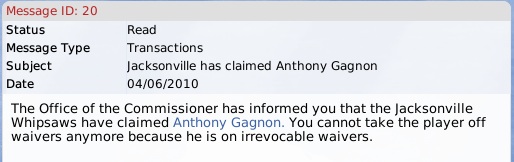
If the waiver was revocable, you have a certain amount of time to take the player off waivers. If you fail to do so, or if the waiver was irrevocable, you will receive a message like the one below.
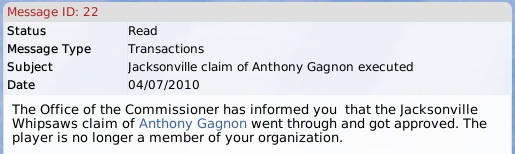
Claiming a Player
To claim a player, use the right-click menu on the Waiver Wire page and select Claim Player. If another team with a worse record has already claimed the player, your claim will be denied outright. However, if it is accepted, you will receive a notification. Once the waiver period has passed, you will receive a message like the following.

The claimed player lands in your DFA (designated for assignment) area, which can been seen on the Waivers & DFA sub-screen of the Transactions page. Also, any player acquired by waiver claim who was on his previous team's secondary roster must also be placed on the acquiring team's secondary roster.
Multiple Claiming Teams
Claims for a waived player are 'on hold' until the end of the waiver period. That is, waiver claims are not on a first-come, first-served basis. The league takes note of all the teams claiming a certain player and processes those claims once the waiver period has ended.
If more than one club in the same subleague claims a player, the club currently lower in the standings gets the player. (If fewer than 31 days have passed in the current season, then last season's won-lost records are used for this purpose.)
helpx_waivers.tpl
A number of roster transactions in the baseball world require a player to go through the waiver process, wherein a player is 'placed on waivers' for a certain number of days. This number is customizable in the Roster Rules section of the Rules page. While a player is on waivers, he can be claimed by any team in the league, which can then take ownership of the player and his current contract. If the player is not claimed, he is said to have 'cleared waivers', and his team can proceed with whatever transaction it was planning. In some cases, a team can remove a player from the waiver wire if it is notified that he has been claimed ('revocable' waivers). In other cases, it cannot withdraw the player ('irrevocable' waivers).
There are numerous tricky scenarios within the waiver process, and OOTPB does not quite replicate all the rules that exist in professional baseball. This section should give you a somewhat clearer picture of waivers in OOTPB.
When Must a Player Be Placed on Waivers?
In OOTPB, a team must place a player on waivers in any of the following scenarios.
1.The player is being removed from the secondary roster (this is called outright waivers).
2.The player is being demoted to the minor leagues from the major league club and is out of option years (this is also outright waivers).
3.The player is being demoted to the minor leagues from the major league club and has three or more years of major league service time (major league waivers).
4.The player is being released (unconditional release waivers).
Outright Waivers
When a player is placed on outright waivers, that player is made available to any team in the league that wants to claim him. If the player clears these waivers, the club can process the transaction it wanted to undertake (remove him from the secondary roster, demote him to the minors, and so on), as long as no other provisions need to be met, such as gaining the player's permission. This waiver is irrevocable, meaning that if the player is claimed by another team, he is lost by the waiving team with no compensation.
Unconditional Release Waivers
When a player is placed on unconditional release waivers, he is removed from all rosters (active and secondary) and made available to any team in the league at his current contract. If a team claims the player, it takes responsibility for his contract, with the waiving team receiving no compensation. A player placed on unconditional release waivers is free to speak to other teams about potential employment, but he cannot sign a contract with another team until he clears waivers. If a player is claimed on unconditional release waivers, he is told of his new team after the waiver period is over, and he has five days to decide whether to report to his claiming team or to terminate his contract. If the player elects to terminate his contract, he is a free agent but not entitled to any termination pay (in other words, the remainder of his guaranteed contract). This waiver is also irrevocable.
Major League Waivers
Major league waivers are used to demote a player who has three or more years of major league service time but who still has option years remaining. These waivers are revocable, so if a player is claimed during this time, the player can be pulled back and remain on the active roster. Major league waivers can be asked for a player only once in 30 days; if a player is placed on major league waivers a second time during this period, those waivers are considered irrevocable, and claimed players are lost by the waiving team with no compensation.
More commonly, major league waivers are seen after the trading deadline, typically from August 1 to the end of the major league regular season. Players who clear major league waivers during that time can be traded after the July 31 trading deadline, although most of these trades and waivers are done before August 31 in order for the newly acquired players to be eligible for the playoff roster.
Revocable versus Irrevocable Waivers
In some cases, a team can remove a player from the waiver wire if it is notified that he has been claimed ('revocable' waivers). In other cases, it cannot withdraw the player ('irrevocable' waivers).
In OOTPB, in waivers are irrevocable when you are trying to send a player who is out of options to the minors. They are revocable in other cases.
How Waivers Work
When a player is placed on waivers, he is made available to every team in the league for a certain amount of time, defined in the league setup. General managers can review the list of players on the 'waiver wire' on the Waivers page at any time, and can attempt to claim a player. If the waivers are irrevocable, then the claiming team claims the player. Once this happens, the general manager of the team waiving the player will receive a message saying that the player has been claimed. If the claim is revocable, the general manager of the waiving team will receive a notice that the player has been claimed and will have an opportunity to remove the player from the waiver wire. If a team claims a player off waivers, it takes responsibility for the player and his contract.
If a player placed on major league waivers is not claimed by another team during a certain number of days after waivers have been requested, then the players is said to have cleared waivers, and the team has secured waivers for the remainder of the waiver period.
What does that mean? Essentially, the team can do with the player's contract as it pleases. This generally means one of three events will happen.
1.It can send him to the minors (subject to his consent, if he's a veteran player; more on that below).
2.It can release him, which makes the player a free agent and thus available to sign with any team.
3.It can trade him to another team, even if the trading deadline has passed. Any trades made after the trading deadline can involve only players who have cleared waivers.
Waiving a Player
There are two ways to waive a player in OOTPB:
1.Go to the Waivers & DFA sub-screen of the Transactions page, and drag the player to the Waivers box, usually located in the lower left:
2.Right-click on any player, select Transactions, then select Waiver Player or Waive & Designate for Assignment:
Either way that you waive a player, you will receive this warning message:
This option allows you to instruct the game to automatically pull back your player from revocable waivers if claimed by another team.
Once the waiver period has passed, you can reassign your player as desired.
Note: In the real world, waivers last for three business days, not calendar days. In OOTPB, waivers last for a certain number of calendar days.
When Your Waived Player is Claimed
If a waived player is claimed by another team, you will receive a message like the following:
If the waiver was revocable, you have a certain amount of time to take the player off waivers. If you fail to do so, or if the waiver was irrevocable, you will receive a message like the one below.
Claiming a Player
To claim a player, use the right-click menu on the Waiver Wire page and select Claim Player. If another team with a worse record has already claimed the player, your claim will be denied outright. However, if it is accepted, you will receive a notification. Once the waiver period has passed, you will receive a message like the following.
The claimed player lands in your DFA (designated for assignment) area, which can been seen on the Waivers & DFA sub-screen of the Transactions page. Also, any player acquired by waiver claim who was on his previous team's secondary roster must also be placed on the acquiring team's secondary roster.
Multiple Claiming Teams
Claims for a waived player are 'on hold' until the end of the waiver period. That is, waiver claims are not on a first-come, first-served basis. The league takes note of all the teams claiming a certain player and processes those claims once the waiver period has ended.
If more than one club in the same subleague claims a player, the club currently lower in the standings gets the player. (If fewer than 31 days have passed in the current season, then last season's won-lost records are used for this purpose.)
helpx_waivers.tpl